
Blog
Radiology Tech Salary 2026: How Much Do You Really Make?

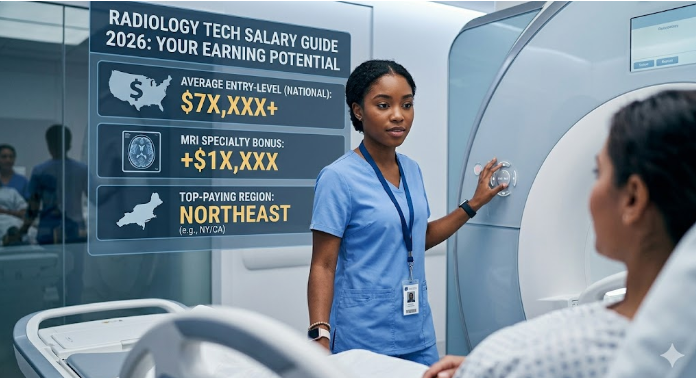
If you have ever wondered what a radiology tech salary looks like in today’s world, you are in the right place! Choosing a career in healthcare is a big move. You want to make sure the time and money you spend on school actually pay off. The good news? Radiology is one of the most stable and rewarding fields you can enter with just a two-year degree.
Working as a radiologic technologist (often called a “rad tech”) isn’t just about pushing buttons on a big X-ray machine. It is about being a vital part of a medical team. You are the one who captures the clear images doctors need to save lives. But let’s be honest—the paycheck matters too. In 2026, the demand for diagnostic imaging is higher than ever. With an aging population needing more scans, hospitals are competing for skilled workers.
In this guide, we will break down the numbers. We’ll look at entry-level pay, how much your location matters, and how you can boost your earnings by specializing in things like MRI or CT scans. Whether you are a student or looking to switch careers, here is everything you need to know about your earning potential.
What Is the Average Radiology Tech Salary in 2026?
As we move through 2026, the national average for a radiology tech salary has seen a steady climb. According to the latest labor data, the median annual pay is approximately $78,000. This works out to about $37.50 per hour.
However, “average” doesn’t tell the whole story. If you are just starting out, you might see offers closer to $52,000. On the flip side, senior techs or those in high-cost areas like California can easily clear $100,000 a year. It is a wide range because so many things affect your pay. Your education, your specific certifications, and even the “shift” you work can change your bank balance.
How Experience Changes Your Paycheck
Experience is a huge factor in your radiology tech salary. Like most jobs, the longer you do it, the more you earn. But in radiology, experience also means you get faster and better at positioning patients, which makes you more valuable to a busy hospital.
- Entry-Level (0–2 Years): You are fresh out of school and learning the ropes. Expect to earn between $48,000 and $60,000.
- Mid-Career (5–10 Years): By now, you are a pro. You might be training students or taking on lead roles. Most techs at this stage earn between $75,000 and $90,000.
- Late Career (15+ Years): Senior technologists often move into management or highly specialized departments. At this level, salaries frequently top $95,000 to $110,000.
Top 5 Highest Paying States for Radiology Techs
Where you live is probably the biggest factor in your radiology tech salary. High-demand states with a high cost of living usually pay the most. Here are the top performers in 2026:
| State | Median Annual Salary |
| California | $95,000 – $115,000 |
| Massachusetts | $88,000 – $98,000 |
| Washington | $85,000 – $95,000 |
| Hawaii | $82,000 – $92,000 |
| Oregon | $80,000 – $90,000 |
While these numbers look amazing, remember to check the “real value.” A $100k salary in San Francisco might feel the same as a $70k salary in Texas once you pay for rent and groceries!
Radiology Tech vs. Radiologic Technologist: Is There a Difference?
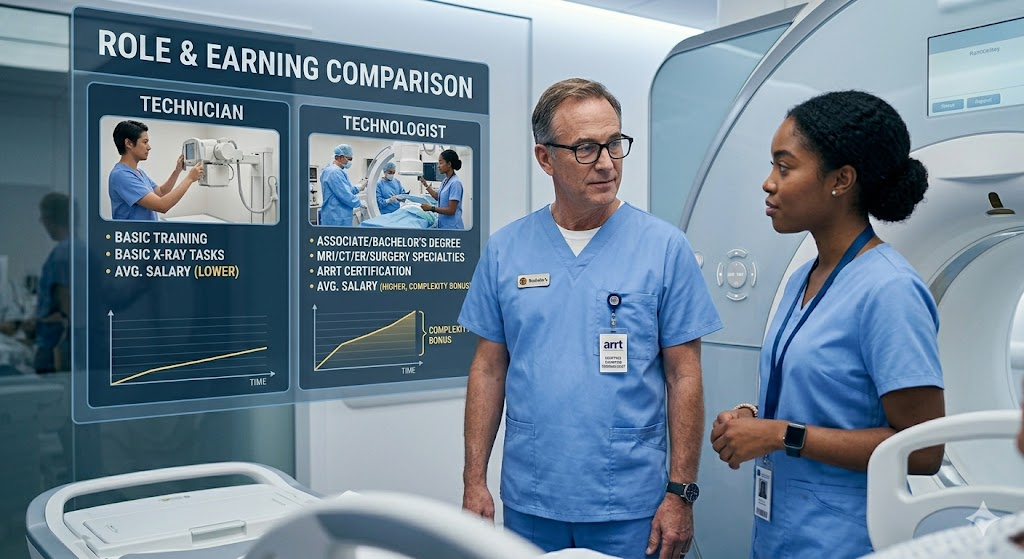
You might hear people use these terms interchangeably, but there is a small technical difference. A “Technician” often refers to someone with basic training who handles simpler X-ray tasks. A “Technologist” usually has a higher level of education (like an Associate or Bachelor’s degree) and is certified by the ARRT.
In the professional world, the radiology tech salary for a “Technologist” is usually higher. This is because technologists are trained to handle more complex machinery and can work in specialized areas like the ER or surgery suites. Most modern job postings are looking for Technologists, even if the title says “Tech.”
How Specializing in MRI or CT Boosts Your Income
If you want to maximize your radiology tech salary, you shouldn’t stop at basic X-rays. Cross-training is the “secret sauce” to a bigger paycheck. By getting a “post-primary” certification, you become a dual-modality tech.
- MRI Technologists: On average, MRI techs earn $10,000 to $15,000 more per year than general rad techs.
- CT Technologists: Computed Tomography (CT) is high-speed and high-demand. Getting your CT wings can easily add $5,000 to $8,000 to your base pay.
- Mammography: This specialized field is growing fast and often offers very stable daytime hours with competitive pay.
The Impact of Work Settings on Your Earnings
Not all workplaces are created equal. Where you choose to hang your lead apron matters.
- Hospitals: Usually pay the best and offer the most overtime and “shift differentials” (extra pay for nights and weekends).
- Outpatient Clinics: These offer great “9-to-5” schedules but might pay a bit less than a major trauma center.
- Physician Offices: These are often the most relaxed environments, but the radiology tech salary here is typically on the lower end of the spectrum.
- Travel Teching: If you are adventurous, travel radiology pays the most! You can earn $2,500+ per week plus housing stipends.
Education Requirements: From Classroom to Clinic
To earn a professional radiology tech salary, you generally need an Associate Degree in Radiologic Technology. These programs take about two years. You’ll spend time in the classroom learning about anatomy and radiation physics, and then you’ll spend hundreds of hours in a hospital doing “clinicals.”
After graduation, you must pass the ARRT (American Registry of Radiologic Technologists) exam. This “R” after your name is your ticket to a high-paying job. Some people choose to get a Bachelor’s degree, which can help if you want to move into hospital management later on.
Hidden Perks: Beyond the Base Salary
When looking at a radiology tech salary, don’t forget the “extras.” Healthcare jobs often come with fantastic benefits packages.
- Shift Differentials: Working the 11 PM to 7 AM shift? You might get an extra $4 to $6 per hour.
- Sign-on Bonuses: Because of the shortage, many hospitals offer $5,000 to $15,000 just for joining their team.
- Tuition Reimbursement: Many employers will pay for you to go back to school to learn MRI or CT!
- Overtime: Radiology is a 24/7 field. If you are willing to work extra, you can significantly increase your take-home pay.
The Job Outlook: Will the Demand Stay High?
Good news—the future looks bright! The Bureau of Labor Statistics predicts that jobs in this field will grow much faster than average. As the “Baby Boomer” generation gets older, they need more diagnostic imaging for broken bones, heart issues, and cancer screenings.
Because of this demand, your radiology tech salary is likely to stay strong. You won’t have to worry about your job being replaced by a robot anytime soon; patients need a human touch to keep them calm and ensure they are positioned correctly for a safe, accurate scan.
Comparing Radiology Salaries to Other Medical Jobs
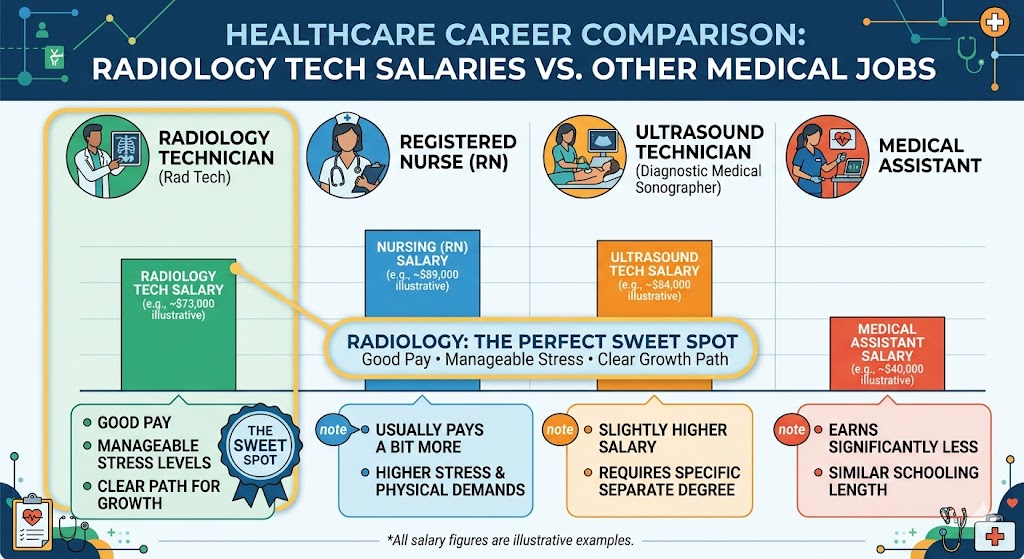
How does a radiology tech salary stack up against other healthcare careers?
- Nursing (RN): Usually pays a bit more, but the stress levels and physical demands are often much higher.
- Ultrasound Tech: Earns slightly more than a rad tech but requires a very specific, separate degree.
- Medical Assistant: Earns significantly less, usually around $40,000, despite having similar schooling lengths.
Radiology offers a perfect “sweet spot” of good pay, manageable stress, and a clear path for growth.
Conclusion
A radiology tech salary offers a fantastic way to reach the middle class and beyond with just a two-year investment in school. In 2026, the combination of high demand, specialty bonuses, and geographic flexibility makes this a “gold medal” career choice.
If you enjoy science, helping people, and working with cool technology, this is the path for you. Start by looking at accredited programs in your area and talking to local techs. Your journey to a $80k+ paycheck starts with that first step!
Frequently Asked Questions
1. What is the starting radiology tech salary for new grads?
Most new graduates can expect to start between $50,000 and $60,000. This depends heavily on your state and whether you work in a big city or a small town.
2. Can I earn $100k as a radiology tech?
Yes! To reach six figures, you usually need to live in a high-paying state (like California), have 10+ years of experience, or specialize in MRI or Interventional Radiology.
3. Does a Bachelor’s degree increase my radiology tech salary?
Not always immediately. For daily clinical work, an Associate degree is usually enough. However, a Bachelor’s degree is often required if you want to become a department manager or a lead technologist.
4. How long does it take to become a radiology tech?
Most people finish their Associate degree in 22 to 24 months. After that, you just need to pass your certification exam to start working.
5. Which specialty pays the most for rad techs?
Radiation Therapy and Dosimetry usually offer the highest salaries, often exceeding $100,000. Among imaging techs, MRI and Interventional Radiology are the top earners.
6. Is the radiology tech salary higher in hospitals or private clinics?
Generally, hospitals pay more. They offer higher base rates and more opportunities for overtime and shift bonuses, whereas clinics usually offer more stable, daytime hours.


88IBET: Introduction, Features, and Platform Overview

Stacie Zabka: Life, Family, and Public Profile

HappyMod: A Complete Guide to the Popular Modded App Platform

Gareth Varey: The Architect of Modern Artist Management

Liza Tarbuck Illness: Health, Career, and Public Awareness

son simon now simon anthony blackburn: From Celebrity Son to Private Life
-
 Fashion8 months ago
Gareth Varey: The Architect of Modern Artist Management
-
 CALEBRITIES8 months ago
Liza Tarbuck Illness: Health, Career, and Public Awareness
-
 Business8 months ago
son simon now simon anthony blackburn: From Celebrity Son to Private Life
-

 Politics7 months ago
Jeffrey Donaldson Daughter Claire: Family Life, Privacy, and Personal Influence
-

 Entertainment8 months ago
Alice Bhandhukravi Illness: Separating Fact from Rumor and Understanding Her Health Status
-

 Politics8 months ago
Piers Pottinger: A Comprehensive Profile of a PR and Corporate Communications Veteran
-

 Business8 months ago
Is Peter Cardwell Married? A Deep Dive Into His Life, Career, and Personal Relationships
-

 Sports8 months ago
Desislava Bozhilova Married: Exploring Public Curiosity and a Strongly Guarded Private Life