
Blog
How Much Does a Cloud Weigh? The Surprising Truth Explained

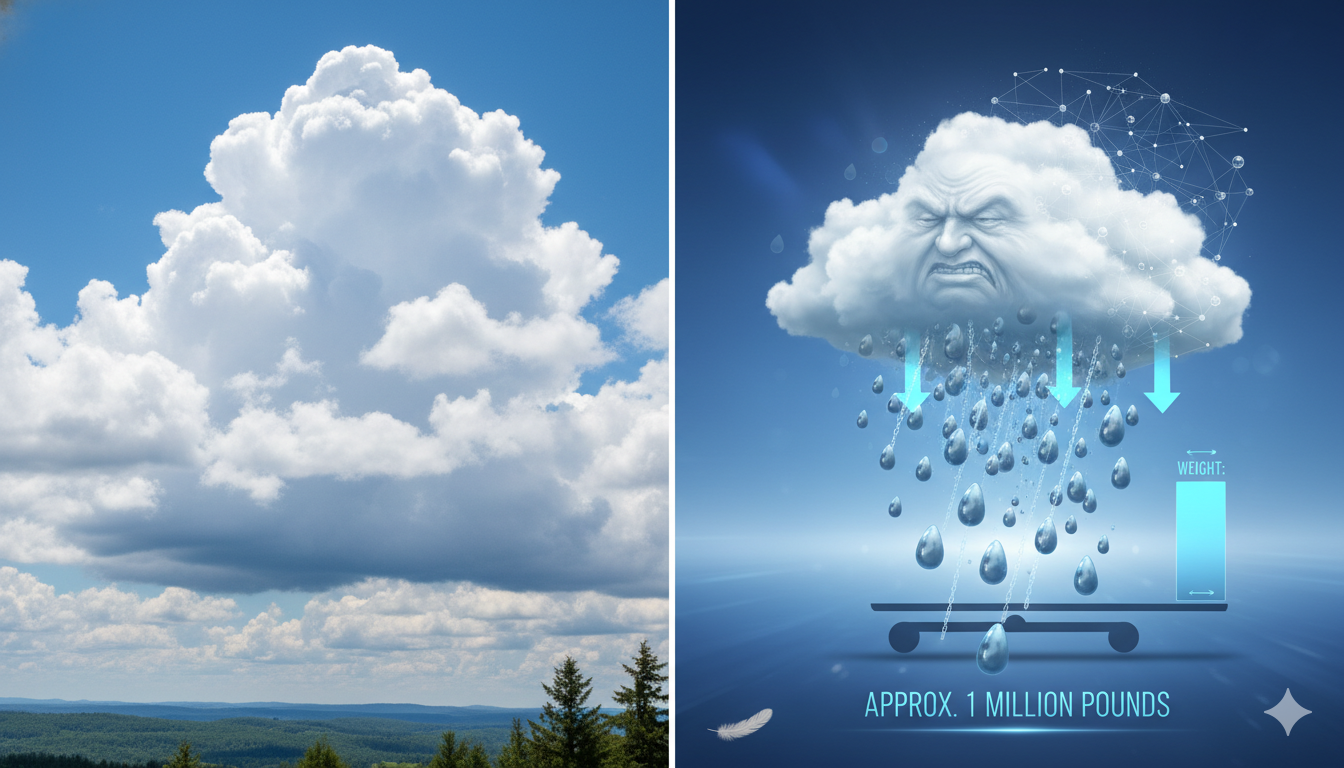
Have you ever looked up at a bright blue sky on a sunny day? How Much Does a Cloud Weigh You probably saw big, fluffy white clouds drifting by. They look like soft piles of cotton candy. Because they float so softly, it is easy to think they weigh nothing at all. You might believe they are as light as a feather. But science tells us a very different story. The truth is that clouds are actually very heavy.
In this article, we will answer a fun question: how much does a cloud weigh? We will look at how scientists measure things in the sky without using a giant scale. We will also learn why these huge, heavy objects do not fall down on our heads. Get ready to discover the amazing secret weight of the sky. The answers will surprise you and change how you look at a rainy day.
The Secret Substance of a Fluffy Cloud
To understand how much does a cloud weigh, we first need to know what a cloud is made of. It looks like smoke or steam, but it is actually made of water. When warm air rises from the ground, it carries invisible water vapor up into the sky. As that air gets higher, it cools down.
When the air cools, the invisible gas turns back into tiny liquid water droplets or small bits of solid ice. Millions of these tiny droplets bunch together to form the shapes we see. Even though one tiny droplet is very light, they add up quickly. It is just like how a single grain of sand weighs almost nothing, but a whole beach is incredibly heavy.
How Scientists Weigh Something in the Air
You cannot put a piece of the sky on a kitchen scale. So, how do we know how much does a cloud weigh? Scientists use math and physics to find the answer. They look at two main things: the size of the cloud and its density. Density means how much stuff is packed into a certain amount of space.
Meteorologists use airplanes and radar tools to measure how big a cloud is from side to side and top to bottom. Once they know the total volume, they figure out how much water is inside each cubic meter. By multiplying the size by the density, they can calculate the total weight without ever touching the sky.
How Much Does a Cloud Weigh? The Numbers Revealed
Let us look at a typical, happy-looking fluffy cloud. Scientists call this a cumulus cloud. A normal cumulus cloud is about one kilometer long, one kilometer wide, and one kilometer tall. That makes it a huge cube floating in the air.
When you do the math for this size, the answer is shocking. A standard fair-weather cumulus cloud contains about 500,000 kilograms of water. That means how much does a cloud weigh comes out to around 1.1 million pounds! That is a massive amount of weight hanging right above our neighborhoods every single day.
Comparing Cloud Weight to Real-World Objects
It is hard to picture 1.1 million pounds in your mind. Let us compare how much does a cloud weigh to heavy things we see on Earth. That way, we can really understand the scale of a single fluffy cloud.
A million pounds is equal to about 100 large adult elephants. Imagine 100 elephants walking across the sky! It is also the same weight as five fully loaded commercial airplanes or 300 mid-sized cars. The next time you look up at a single puffy cloud, remember that you are looking at the weight of a whole parking lot floating over your head.

The Complete Cloud Weight Comparison Table
Different types of clouds have different amounts of water. A thin, wispy cloud has less water than a dark, scary storm cloud. The table below breaks down the estimated weights of different cloud types so you can compare them easily.
| Cloud Type | Common Appearance | Average Weight (Pounds) | Real-World Equivalent |
| Cirrus Cloud | High, thin, and wispy | 20,000 Pounds | 2 Adult Elephants |
| Cumulus Cloud | Medium, white, and puffy | 1.1 Million Pounds | 100 Adult Elephants |
| Stratus Cloud | Low, grey, and flat | 10 Million Pounds | 900 Adult Elephants |
| Cumulonimbus | Giant, dark storm cloud | 1 Billion Pounds | 90,000 Adult Elephants |
Why Do Heavy Clouds Stay Float in the Sky?
Now you know How Much Does A Cloud Weigh, but this brings up a big puzzle. If a cloud weighs a million pounds, why does it stay up in the sky? Why does it not crash down to the ground like a rock? The secret lies in how the water is spread out.
The water in a cloud is not in one big bucket. It is split into trillions of tiny droplets spread across a massive space. These droplets are so small that the gentle warm air rising from the ground is strong enough to push them upward. The upward push of the warm air balances the downward pull of gravity.

Understanding Cloud Density and Air Weight
There is another scientific reason why these heavy objects float. It has to do with the weight of the air itself. We do not feel it, but dry air has weight and density too. The air surrounding a cloud is actually denser than the cloud itself.
A cloud is filled with warm, moist air, which is lighter than cold, dry air. Because the cloud is less dense than the dry air around it, it floats on top of the heavier air. It works just like a piece of wood floating on top of water, or a hot air balloon rising up into the morning sky.
What Happens When a Cloud Gets Too Heavy?
Clouds do not stay the same size forever. They are always changing as more warm air pushes water vapor into them. So, what happens when how much does a cloud weigh starts to increase past its normal limit? The tiny water droplets inside start to bump into each other.
When they bump together, they join to create larger, heavier drops. Soon, these drops become too big and heavy for the rising air to hold up. Gravity wins the battle, and the water falls down to the Earth. We call this process rain!
Fun Facts About Earth’s Flying Water Wonders
Clouds are full of amazing surprises that show us how beautiful our planet is. For example, did you know that clouds can travel across the sky at speeds faster than 30 miles per hour? They look slow because they are so far away, but they are actually rushing along with high-altitude winds.
Another fun fact is that clouds help keep our planet cool. They act like a giant sunshade for the Earth, reflecting bright sunlight back out into space. Without them, our days would be much hotter, and our oceans would dry up quickly.
Conclusion: Looking Up with New Eyes
We started with a simple question: how much does a cloud weigh? We discovered that those light, fluffy shapes are actually giant water monsters weighing over a million pounds. They hold the weight of 100 elephants, yet they float gracefully because of the magic of density and warm rising air currents.
Nature is full of incredible secrets hidden right in plain sight. The next time you go outside and look up at the sky, take a moment to admire those floating giants. Do you have a favorite type of cloud to watch? Let us know your thoughts, and share this cool science fact with your friends!
Frequently Asked Questions
1. Can a cloud ever fall down to the ground all at once?
No, a cloud cannot drop to the ground like a solid object. The water is spread out into trillions of tiny droplets. When it gets too heavy, it falls slowly as separate raindrops.
2. What is fog, and does it weigh the same?
Fog is just a cumulus cloud that formed close to the ground. It follows the same rules for how much does a cloud weigh, but because it is spread out along the grass and roads, we only see it as a thick mist.
3. Do dark storm clouds weigh more than white clouds?
Yes, dark storm clouds weigh much more. They look dark because they are packed tight with a massive amount of water droplets. This thickness blocks the sunlight from passing through them.
4. How many gallons of water are in a normal cloud?
A standard white cumulus cloud holds about 130,000 gallons of water. That is enough water to fill a large backyard swimming pool more than five times over!
5. Why do some clouds look like lines behind airplanes?
Those are called contrails. They are artificial clouds made when hot airplane exhaust hits the freezing cold air high in the sky. They are very light and do not weigh much at all.


Integrated Aquatic Protection: Evaluating Advanced Emergency Response Programs

Rachel Caesar: Biography, Background, Career, and Personal Life

US Teacher Appreciation Day 2025: Date, History, Ideas, and Ways to Celebrate

Gareth Varey: The Architect of Modern Artist Management

Liza Tarbuck Illness: Health, Career, and Public Awareness

Jeffrey Donaldson Daughter Claire: Family Life, Privacy, and Personal Influence
-
 Fashion9 months ago
Gareth Varey: The Architect of Modern Artist Management
-
 CALEBRITIES9 months ago
Liza Tarbuck Illness: Health, Career, and Public Awareness
-
 Politics8 months ago
Jeffrey Donaldson Daughter Claire: Family Life, Privacy, and Personal Influence
-

 Entertainment9 months ago
Alice Bhandhukravi Illness: Separating Fact from Rumor and Understanding Her Health Status
-

 Business9 months ago
son simon now simon anthony blackburn: From Celebrity Son to Private Life
-

 Politics9 months ago
Piers Pottinger: A Comprehensive Profile of a PR and Corporate Communications Veteran
-

 Sports9 months ago
Desislava Bozhilova Married: Exploring Public Curiosity and a Strongly Guarded Private Life
-

 Entertainment9 months ago
Is Alice Bhandhukravi Married? A Complete Look at Her Personal Life and Career