
Blog
Robot Joint Module Design Basics for Robotics Engineers

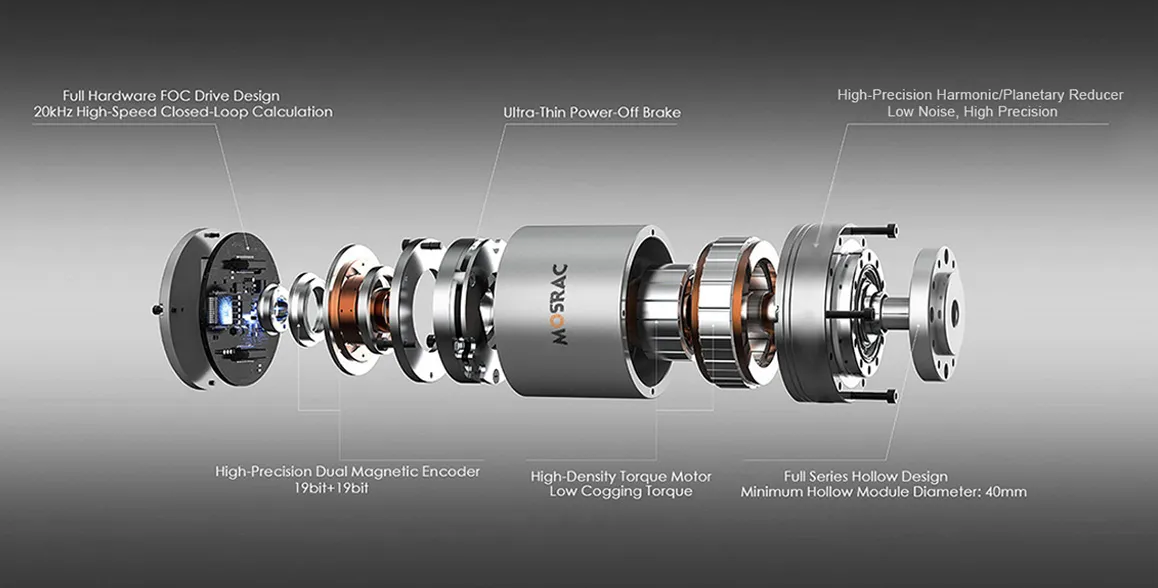
1. Introduction to Robot Joint Modules
Robot joint modules are the fundamental building blocks of robotic systems. They define how links in a robot move relative to each other and directly influence performance factors such as precision, robot joint module payload capacity, speed, and energy efficiency. A well-designed joint module integrates mechanical structure, actuation, sensing, and control into a compact, reliable unit.
In modern robotics—from industrial arms to humanoids—joint modules are increasingly designed as modular, “plug-and-play” units to simplify assembly and maintenance.
2. Types of Robot Joints
Understanding joint types is essential for design:
- Revolute Joint (Rotary Joint): Allows rotation around a single axis. Common in robotic arms.
- Prismatic Joint (Linear Joint): Enables sliding motion along one axis.
- Spherical Joint: Provides multi-axis rotation, similar to a human shoulder.
- Universal Joint: Allows rotation in two perpendicular axes.
Most robotic manipulators use a combination of revolute joints due to their simplicity and control efficiency.
3. Key Design Requirements
A joint module must satisfy multiple engineering requirements: robot joint module
- Torque capacity: Must handle required load without failure.
- Backlash minimization: Critical for precision applications.
- Compactness: Space-efficient integration is essential.
- Efficiency: Low energy loss in transmission.
- Durability: Long operational life under repeated cycles.
- Thermal stability: Prevent performance drift under heat.
These requirements often conflict, requiring careful trade-offs.
4. Mechanical Design Considerations
Mechanical structure forms the backbone of a joint module. Key aspects include:
- Gear systems: Harmonic drives, planetary gears, or belt systems are commonly used.
- Bearing selection: Cross-roller or angular contact bearings improve stiffness.
- Transmission ratio: High reduction ratios increase torque but may reduce speed.
- Backlash control: Harmonic drives are preferred in precision robotics due to near-zero backlash.
Proper alignment of mechanical components is critical to avoid wear and vibration.
5. Actuation Systems
Actuators convert electrical energy into motion. Common choices include:
- DC brushed motors: Simple and cost-effective but less durable.
- Brushless DC (BLDC) motors: High efficiency and widely used in modern robotics.
- Servo motors: Integrated feedback systems for precise control.
- Direct drive motors: No gearbox, offering smooth motion but requiring high torque motors.
The choice depends on torque requirements, precision, and system cost.
6. Sensors and Feedback Integration
Sensors enable closed-loop control of joint modules:
- Encoders: Measure position and speed (optical or magnetic types).
- Torque sensors: Provide force feedback for compliance control.
- Temperature sensors: Protect against overheating.
- Current sensors: Estimate load and motor behavior.
High-resolution encoders are essential for precision robotics such as surgical or humanoid systems.
7. Control Architecture Basics
A joint module typically uses a layered control system:
- Low-level control: Motor current control for torque regulation.
- Mid-level control: Velocity and position control loops.
- High-level control: Motion planning and kinematics.
Modern systems often use PID controllers, while advanced robots may implement model predictive control (MPC) or adaptive control techniques.
8. Materials and Structural Design
Material selection impacts performance and durability:
- Aluminum alloys: Lightweight and widely used in robotic arms.
- Steel: High strength but heavier.
- Carbon fiber composites: High stiffness-to-weight ratio for advanced robots.
- Engineering plastics: Used in low-load or cost-sensitive designs.
Finite Element Analysis (FEA) is commonly used to optimize structural strength and reduce deformation.
9. Common Design Challenges
Engineers often face several challenges:
- Backlash and compliance issues
- Heat dissipation in compact modules
- Vibration and resonance
- Wear and tear in gear systems
- Integration of electronics in limited space
Balancing performance, cost, and reliability remains a major design constraint.
10. Future Trends in Joint Module Design
Robot joint design is rapidly evolving:
- Integrated smart joints: Motor, controller, and sensors in one unit.
- AI-based adaptive control: Real-time optimization of motion.
- Soft robotics integration: Compliant joints for safer human interaction.
- Higher torque density motors: More power in smaller volumes.
- Wireless communication inside joints: Reducing cabling complexity.
These innovations are enabling more capable humanoid and collaborative robots.
11. Conclusion
Robot joint modules are at the heart of every robotic system. Their design requires a multidisciplinary approach combining mechanical engineering, electronics, control theory, and materials science. As robotics advances toward smarter and more autonomous systems, joint modules are becoming more integrated, intelligent, and efficient.
A strong understanding of joint design principles allows robotics engineers to build systems that are not only precise and powerful but also scalable and reliable in real-world applications.


Integrated Aquatic Protection: Evaluating Advanced Emergency Response Programs

Rachel Caesar: Biography, Background, Career, and Personal Life

US Teacher Appreciation Day 2025: Date, History, Ideas, and Ways to Celebrate

Gareth Varey: The Architect of Modern Artist Management

Liza Tarbuck Illness: Health, Career, and Public Awareness

Jeffrey Donaldson Daughter Claire: Family Life, Privacy, and Personal Influence
-
 Fashion9 months ago
Gareth Varey: The Architect of Modern Artist Management
-
 CALEBRITIES9 months ago
Liza Tarbuck Illness: Health, Career, and Public Awareness
-
 Politics8 months ago
Jeffrey Donaldson Daughter Claire: Family Life, Privacy, and Personal Influence
-

 Entertainment9 months ago
Alice Bhandhukravi Illness: Separating Fact from Rumor and Understanding Her Health Status
-

 Business9 months ago
son simon now simon anthony blackburn: From Celebrity Son to Private Life
-

 Politics9 months ago
Piers Pottinger: A Comprehensive Profile of a PR and Corporate Communications Veteran
-

 Sports9 months ago
Desislava Bozhilova Married: Exploring Public Curiosity and a Strongly Guarded Private Life
-

 Entertainment9 months ago
Is Alice Bhandhukravi Married? A Complete Look at Her Personal Life and Career