
Blog
Moisture Vapor Barrier Epoxy: Complete Guide for Concrete Flooring

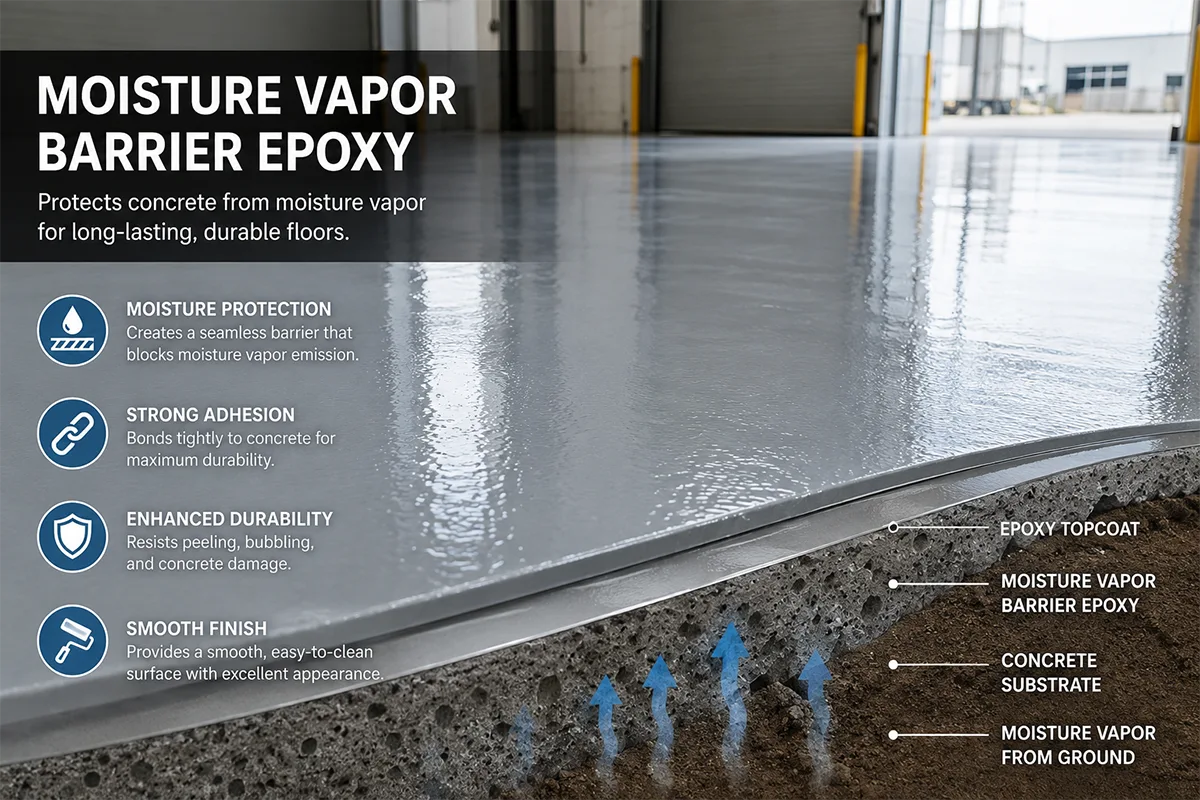
Concrete is one of the most widely used materials for floors in homes, garages, warehouses, factories, and commercial buildings. Although concrete looks solid, it contains tiny pores that can allow moisture to move through the slab. This moisture can become a problem when an epoxy coating is installed over the surface.
A moisture vapor barrier epoxy can help manage moisture vapor and protect a flooring system from moisture-related problems. It is often used as part of a complete flooring system when concrete moisture levels require additional control.
Understanding how these products work can help property owners, contractors, and facility managers make better flooring decisions.
What Is Moisture Vapor Barrier Epoxy?
A moisture vapor barrier epoxy is a specialized epoxy-based coating or primer designed to help control moisture vapor moving through concrete.
It is normally used underneath or as part of an epoxy flooring system. The material creates a protective layer that helps reduce the impact of moisture moving from the concrete toward the finished floor.
These products are not all identical. Manufacturers may design different formulations for different moisture conditions and flooring systems. Therefore, the product’s technical data should always be checked before installation.
Why Concrete Contains Moisture
Concrete requires water during its mixing and curing process. Some of this water remains inside the slab for a period of time after installation.
Concrete floors located directly over soil can also be exposed to moisture from the ground. Groundwater and poor drainage may increase moisture movement.
Environmental conditions can affect drying as well. Temperature, humidity, ventilation, and slab thickness can influence how quickly concrete releases moisture.
This means a concrete floor can appear dry while moisture is still present below the surface.
How Moisture Damages Epoxy Flooring
Epoxy coatings depend on good adhesion to the concrete substrate. Excessive moisture can interfere with this bond.
When moisture vapor moves upward, pressure can develop underneath the coating. Depending on the flooring system and conditions, this can contribute to bubbling, blistering, peeling, discoloration, or other coating defects.
Moisture can also affect the appearance of some epoxy systems. A coating may develop cloudy areas or lose its intended finish.
The exact result depends on the coating, moisture level, substrate condition, and installation process.
How a Moisture Vapor Barrier Works
A moisture vapor barrier is designed to help limit or manage moisture vapor passing through concrete.
When installed correctly, it forms a layer between the concrete substrate and the subsequent flooring system. This can help create conditions that are more suitable for epoxy installation.
However, a vapor barrier should not be confused with a complete waterproofing system. It may not solve problems caused by active leaks, standing water, or significant hydrostatic pressure.
The manufacturer’s specifications should clearly state the moisture conditions the product can handle.
Benefits of Moisture Vapor Barrier Epoxy
Using an appropriate moisture-control system can provide several advantages.
Helps Reduce Moisture-Related Failures
Moisture management can reduce the risk of certain problems associated with vapor transmission through concrete.
Supports Adhesion
A properly selected system can help create a more suitable surface for subsequent epoxy layers.
Protects the Flooring Investment
Epoxy flooring can represent a significant installation cost. Moisture management can be an important part of protecting that investment.
Supports Long-Term Performance
When combined with proper preparation and installation, moisture control can contribute to a longer-lasting flooring system.
Suitable for Various Applications
Moisture-control systems can be used in many residential, commercial, and industrial flooring projects, depending on product specifications.
Where Moisture Barriers Are Used
Moisture vapor barrier epoxy systems may be considered in warehouses, factories, workshops, garages, basements, retail buildings, and other concrete-floor environments.
Industrial facilities may require moisture control before installing heavy-duty epoxy systems. These floors can also face machinery, forklifts, chemicals, and high traffic.
Garages can have moisture concerns from the ground, especially when concrete is installed directly over soil.
Basements may also experience moisture because of their location below or near ground level.
Every project should be evaluated individually rather than assuming that the same system works everywhere.
Testing Concrete Before Installation
Moisture testing helps determine whether a concrete slab is suitable for the planned flooring system.
Professional flooring installers may use recognized testing methods, including relative humidity testing or other methods specified by the flooring manufacturer.
Testing results should be compared with the acceptable moisture limits provided for the selected product.
Testing is important because visual inspection cannot accurately measure moisture inside a concrete slab.
If moisture levels are too high, additional preparation or moisture-control measures may be necessary before installing the final epoxy system.
Preparing the Concrete Surface
Proper surface preparation is essential for good coating performance.
The concrete should be free from oil, grease, dust, dirt, loose particles, and other contaminants. Existing coatings may also need to be removed if they are incompatible with the new system.
Mechanical methods such as diamond grinding or shot blasting may be used depending on the floor condition.
Cracks, joints, holes, and damaged areas should be inspected and addressed as required.
The final surface should meet the manufacturer’s requirements before the moisture vapor barrier epoxy is applied.
Moisture Vapor Barrier Epoxy Installation
Installation procedures vary between products. Always follow the specific manufacturer’s instructions.
The process generally begins with substrate inspection and moisture testing. Once the surface is properly prepared, the product is mixed according to the specified ratio.
The material may be applied using a roller, squeegee, or other recommended equipment.
Application thickness is important. Too little material may not provide the intended performance, while excessive thickness can affect curing.
Some systems require additional coats or specific waiting periods before the next flooring layer is installed.
Temperature and humidity should also remain within the recommended range throughout the application and curing process.
Choosing the Right Epoxy Product
Selecting the correct product requires careful comparison.
Look at the manufacturer’s technical data sheet for information about moisture limits, coverage, thickness, curing time, application temperature, and compatibility.
Consider the floor’s intended use. A residential garage has different requirements from a large manufacturing plant.
Also consider the complete flooring system rather than focusing on one product. The primer, moisture barrier, base coat, and topcoat should be compatible.
For complex projects, working with an experienced flooring professional can help reduce installation problems.
Common Problems to Avoid
One major mistake is installing epoxy without checking concrete moisture. A floor that looks dry may still have high internal moisture.
Poor surface preparation is another common issue. Contaminants and weak concrete can prevent the coating from bonding properly.
Incorrect mixing can also affect curing and performance. Installers should follow the manufacturer’s specified mixing ratio and working time.
Applying the coating under unsuitable temperature or humidity conditions can create additional problems.
Finally, do not assume that a moisture barrier can correct serious water intrusion. The underlying water source may need to be addressed first.
Maintenance of Epoxy Flooring
Once the flooring system is installed, regular maintenance can help preserve its appearance and performance.
Sweep or vacuum the floor regularly to remove dirt and abrasive particles. Clean spills promptly, especially in industrial environments.
Use cleaning products that are compatible with the coating. Avoid aggressive chemicals unless the manufacturer confirms that they are safe.
Periodic inspections can also identify early signs of damage. Bubbling, peeling, cracks, or discoloration should be investigated rather than ignored.
Frequently Asked Questions
What does a moisture vapor barrier epoxy do?
It helps control moisture vapor moving through a concrete slab and can form part of an epoxy flooring system.
Does every concrete floor need a moisture barrier?
No. The need depends on moisture conditions, the selected flooring system, and the manufacturer’s requirements.
Can epoxy be applied to damp concrete?
Only when the specific product is designed and approved for the measured moisture conditions. Always follow the manufacturer’s limits.
Is a moisture vapor barrier waterproof?
Not necessarily. Vapor-control products are designed for moisture vapor management and may not stop active water intrusion or hydrostatic pressure.
How do I know if my concrete has too much moisture?
Professional moisture testing can provide information about conditions inside the slab. Test results should be compared with the coating manufacturer’s limits.
Can a moisture barrier improve epoxy flooring life?
Proper moisture management can help reduce certain moisture-related failures, but overall service life also depends on preparation, installation, traffic, environment, and maintenance.
Final Thoughts
A moisture vapor barrier epoxy can be an important component of a concrete flooring system when moisture vapor is a concern. It helps manage moisture movement and can support the performance of subsequent epoxy layers.
However, choosing the right product is only one part of the process. Moisture testing, proper surface preparation, correct application, suitable environmental conditions, and compatible flooring layers are all important.
Before starting an epoxy flooring project, evaluate the concrete carefully and follow the manufacturer’s technical requirements. Proper planning can help create a stronger, cleaner, and more durable floor.


HappyMod: A Complete Guide to the Popular Modded App Platform

Kicker and Kicker Online: A Complete Guide to Football Gaming and Entertainment

Blackops Uncovered: The Full Covert Operations Guide

Gareth Varey: The Architect of Modern Artist Management

Liza Tarbuck Illness: Health, Career, and Public Awareness

son simon now simon anthony blackburn: From Celebrity Son to Private Life
-
 Fashion7 months ago
Gareth Varey: The Architect of Modern Artist Management
-
 CALEBRITIES8 months ago
Liza Tarbuck Illness: Health, Career, and Public Awareness
-
 Business8 months ago
son simon now simon anthony blackburn: From Celebrity Son to Private Life
-

 Politics7 months ago
Jeffrey Donaldson Daughter Claire: Family Life, Privacy, and Personal Influence
-

 Entertainment8 months ago
Alice Bhandhukravi Illness: Separating Fact from Rumor and Understanding Her Health Status
-

 Politics8 months ago
Piers Pottinger: A Comprehensive Profile of a PR and Corporate Communications Veteran
-

 Business8 months ago
Is Peter Cardwell Married? A Deep Dive Into His Life, Career, and Personal Relationships
-

 Sports7 months ago
Desislava Bozhilova Married: Exploring Public Curiosity and a Strongly Guarded Private Life